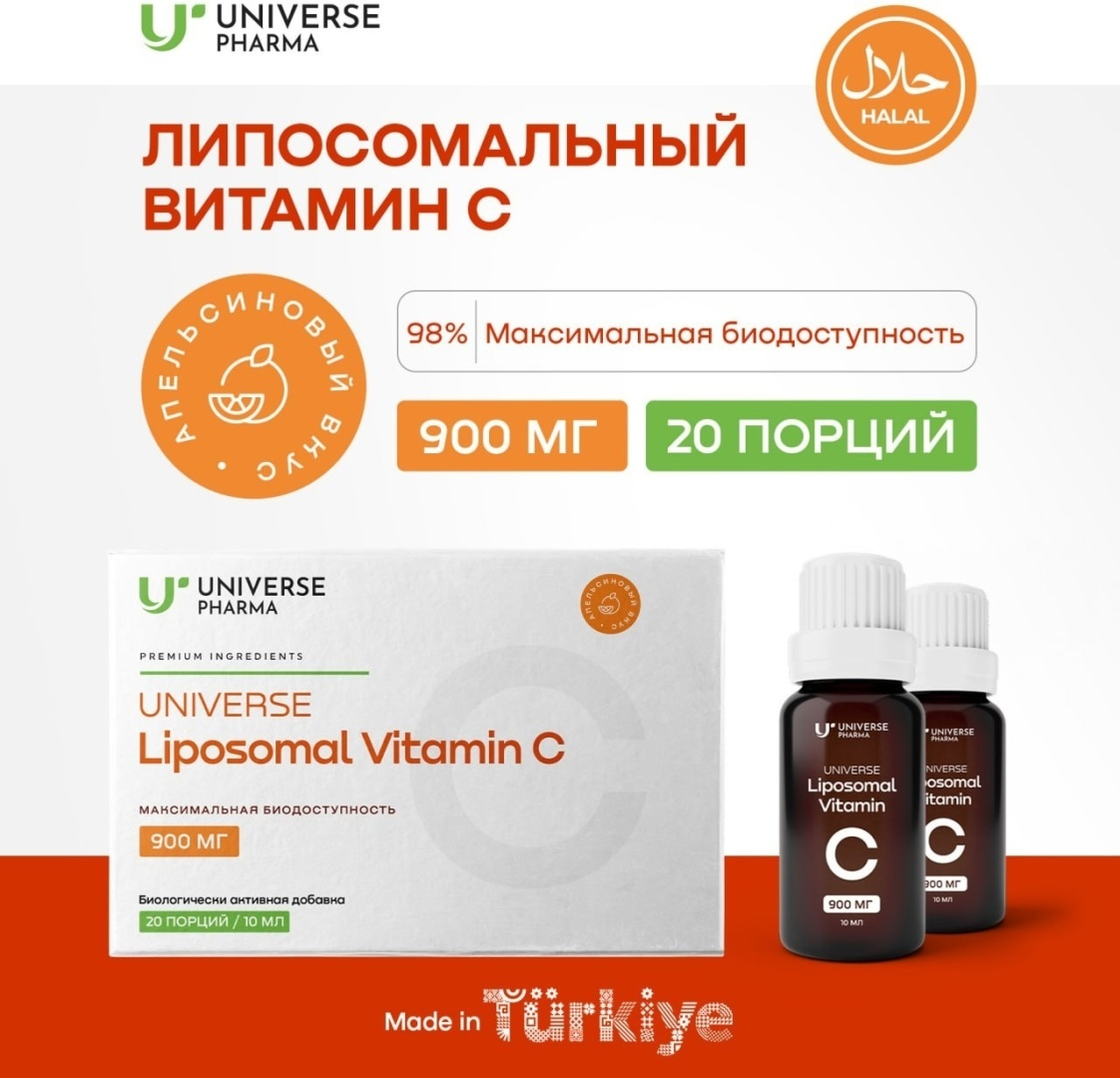
Liposomal vitamin C from Türkiye's Universe Pharma. Each 10 ml stick delivers 900 mg of vitamin C as sodium ascorbate — a mild neutral form that does not irritate the gastric mucosa and, unlike free ascorbic acid, can be taken at high dose without heartburn. The stick additionally carries 1000 mg of phospholipid matrix: phosphatidylcholine 530 mg, phosphatidylinositol 316 mg, phosphatidylethanolamine 154 mg. The bilayer phospholipid envelope protects ascorbate from oxidation and delivers it to the cell via the same pathway by which the cell membrane exchanges fat-soluble substances. Comparative measurements show bioavailability of about 98% versus 30-50% for tablet forms.

Sodium ascorbate is the sodium salt of vitamin C. Same molecule, but in the neutral environment it does not irritate the gastric mucosa, unlike free ascorbic acid. The phospholipid bilayer carries it across the cell membrane through the same pathway the cell uses for fat-soluble compounds.
The phospholipids in the shell — phosphatidylcholine, inositol and ethanolamine — are the same molecules that build the membranes of the liver, skin, and immune-tissue cells. When the liposome reaches the gut epithelium, its outer layer is not recognised as foreign — it merges with the cell membrane, and vitamin C enters without active transport.
The daily vitamin C requirement is 60-90 mg for an adult. One stick contains 900 mg — a tenfold reserve. This is not an overdose: oral ascorbic acid has an absorption ceiling around 200 mg per intake due to SVCT transporters, and the liposomal form bypasses that ceiling — so plasma level holds longer and covers periods when SVCT is already occupied with something else.
Regular ascorbic acid is an organic acid with a pKa around 4. At doses of 500 mg and above, some people get heartburn, nausea, and loose stool — the gastric mucosa reacts to the free acidic ion. Sodium ascorbate is the sodium salt of the same molecule; in the gastric environment it is neutral and does not damage the epithelium.
In ordinary ascorbic-acid tablets, absorption is limited by active transport through SVCT proteins. Once those transporters saturate (around 200 mg per intake), the rest passes through and is excreted in urine. That's why large doses from ordinary forms work less well than the label suggests.
The liposomal form bypasses that ceiling. Sodium ascorbate is packed inside a bilayer of phospholipids — the same chemical structure as the membrane of any cell in the body. Micelles carry vitamin C directly across the membrane through phospholipid passive diffusion, bypassing the SVCT bottleneck. Comparative plasma-level measurements show bioavailability of about 98% versus 30-50% for ordinary ascorbic acid.
| Serving size | 10 ml (1 stick) |
| Servings per container | 20 |
| Active ingredient | Per serving | % RDA |
|---|---|---|
| Vitamin C (sodium ascorbate) | 900 mg | 1500% |
| Phospholipids (total) | 1000 mg | 14% |
| Phosphatidylcholine | 530.17 mg | † |
| Phosphatidylinositol | 315.70 mg | † |
| Phosphatidylethanolamine | 154.13 mg | † |
| † Daily Value not established. | ||
Purified water, natural orange flavour, glycerol (humectant). Sugar-free, non-GMO, gluten-free, preservative-free.
Do not exceed the recommended daily dose. Contains phospholipids — those with diagnosed lecithin allergy (commonly soy lecithin) should take with caution.
The sodium salt of ascorbic acid. Same vitamin C molecule as in citrus, in a neutral environment — without the mucosal irritation typical of free ascorbic acid at 500 mg and above.
The principal phospholipid of cell membranes. Forms the outer layer of the liposome and carries vitamin C across the membrane through phospholipid passive diffusion, bypassing the SVCT transport ceiling.
Inner component of the liposomes. Participates in intracellular signalling and helps stabilise the micelle structure as it transits the gastrointestinal tract.
The second major membrane phospholipid. Completes the liposome bilayer and ensures it transits the small-intestinal epithelium without breaking apart.
University Collaborations:: Yeditepe · Istanbul Cerrahpasa · Istinye · Nanolab.
Quality Control:: two accredited independent labs · RAN laboratory verification.
Dietary supplement (БАД). Not a medicinal product. Contraindications apply — consult a healthcare professional before use.